
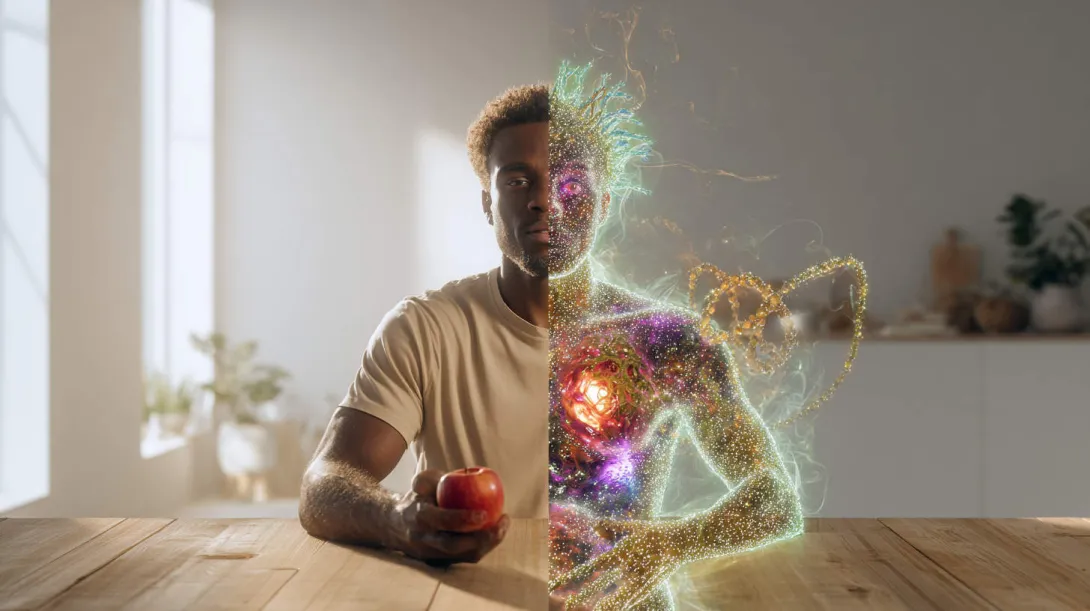
We often talk about food as though it carries a fixed biological outcome.
Protein supports muscle. Fibre supports digestion. Polyphenols are associated with metabolic health. These statements can be useful, but they leave out an important part of the process.
Food enters the body as information and raw material. What happens next depends partly on the community of microorganisms living within the digestive system.
In that sense, healthy food does not work alone.
Your meal continues after you stop eating
Most of us imagine digestion as a fairly direct sequence. We eat, food is broken down, nutrients are absorbed, and the meal is finished.
The reality appears to be more complex.
Some dietary components, particularly fibres and certain polyphenols, are not fully processed in the small intestine. They continue into the colon, where gut microorganisms can transform them into other compounds.
These include short-chain fatty acids and a much wider range of microbial metabolites. Some may interact with the intestinal barrier, immune signalling, appetite regulation and cardiometabolic processes.
This does not mean that the microbiome independently controls health. Nor does every microbial metabolite produce a beneficial effect. The relationship depends on the food, the microbial community, the host and the wider health context.
Still, the underlying idea is useful: your stomach begins the meal, but your microbiome helps finish it.
Every meal has two authors
A meal is usually described through its ingredients and nutritional composition.
How much protein does it contain? How much fibre? What types of fat or carbohydrate?
Those measurements matter. Yet they describe what enters the system, not necessarily everything the system will produce.
Once food encounters the microbiome, it becomes part of a biological collaboration. Microorganisms use dietary substrates, compete for them and convert them into new molecules. The body then responds not only to the original food but also to at least some of the products created during this process.
So perhaps every meal has two authors.
The first is the person choosing and eating the food. The second is the internal ecosystem interpreting what arrives.
This is one reason microbiome research is becoming increasingly relevant to nutrition. It adds another layer between dietary intake and physiological response.
The same food does not guarantee the same result
Nutrition advice often assumes that people will respond similarly to the same meal.
Research into post-meal glucose and lipid responses has challenged that assumption. When people consume identical or comparable foods, their metabolic responses can vary considerably.
Differences in sleep, physical activity, metabolic health, meal timing and genetics may all contribute. The gut microbiome appears to be another part of the explanation.
Studies have found associations between microbial features and individual postprandial responses. Including microbiome information can sometimes improve predictions of how a person will respond to a meal, although this field is still developing and should not be reduced to a simple microbial score.
The conclusion is not that general nutrition guidance has become useless.
Basic principles such as dietary variety, sufficient fibre, adequate protein and limited reliance on heavily processed foods remain meaningful at the population level. But population guidance and individual response are not the same thing.
A food can be nutritious in general while producing a different short-term response in different people.
The food may be the same. The biology is not.
From perfect foods to better matches
The search for a universally perfect food may be asking the wrong question.
A more useful question could be: how does this food interact with this person, in this context, over time?
That shift changes nutrition from a list of isolated products into the study of relationships. Food matters. The person matters. The microbiome matters. So do habits, environment and metabolic state.
We are not yet at the point where a single microbiome test can reliably design the ideal diet for everyone. The science is more nuanced than many commercial promises suggest.
What it does offer is a different way to think.
Inside the digestive system is not an empty processing tube but a living ecosystem. It has accompanied us through every meal, quietly transforming part of what we eat.
You have never eaten alone.
Scientific basis
Sanz Y., Cryan J.F., Deschasaux-Tanguy M. et al. The gut microbiome connects nutrition and human health. Nature Reviews Gastroenterology & Hepatology, 2025. The review examines how diet and the microbiome interact across immune, nervous and cardiometabolic systems.
Berry S.E. et al. Human postprandial responses to food and potential for precision nutrition. Nature Medicine, 2020. The study demonstrated substantial individual variation in glucose and triglyceride responses to meals.
Asnicar F. et al. Microbiome connections with host metabolism and habitual diet from 1,098 deeply phenotyped individuals. Nature Medicine, 2021. The research connected habitual diet, microbial patterns and markers of host metabolism.
Zeevi D. et al. Personalized Nutrition by Prediction of Glycemic Responses. Cell, 2015. The study found highly variable glucose responses to identical meals and incorporated microbiome data into individual prediction models.
Mann E.R. et al. Short-chain fatty acids: linking diet, the microbiome and immunity. Nature Reviews Immunology, 2024. The review describes microbial short-chain fatty acids as mediators between dietary substrates and host physiology.