
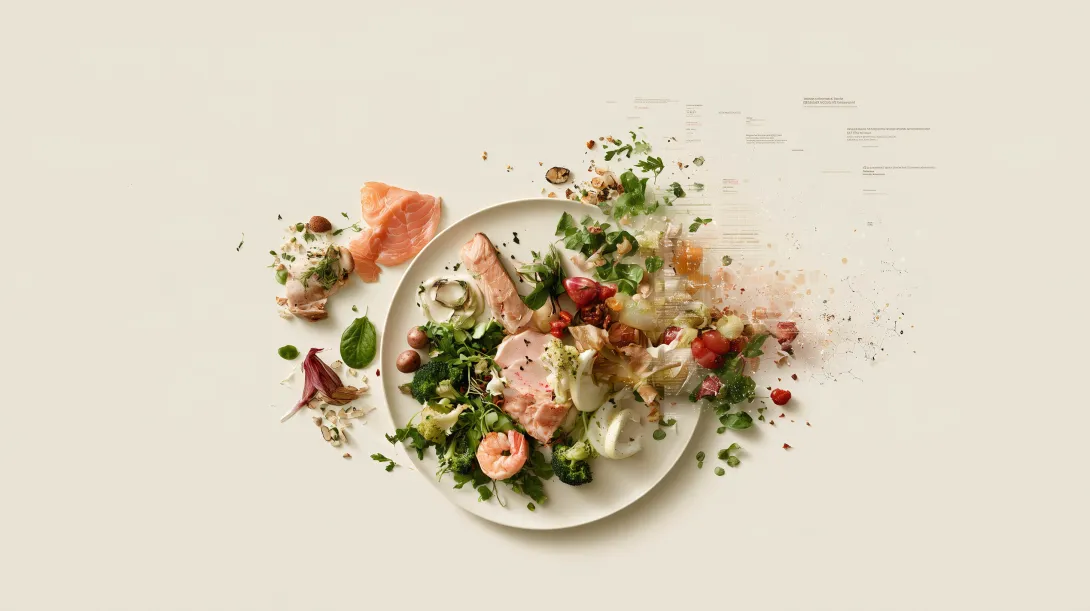
Ask someone what they ate yesterday and the answer may sound straightforward.
Breakfast. Lunch. Dinner. Maybe a snack.
But reconstructing an entire day of eating is surprisingly difficult. A drink between meetings, a handful of nuts, something added to coffee, a sauce, a small evening snack. Some things are forgotten. Others simply do not seem important enough to mention.
This creates a basic problem for nutrition science: how do we study the effects of diet if our picture of the diet itself is incomplete?
Food diaries depend on more than honesty
Self-reported dietary data are valuable. They tell researchers not only what people remember eating, but also something objective measurements cannot easily explain: when they ate, why they chose a food, how it was prepared, and the context around the meal.
Still, self-report depends on memory and attention.
People may omit details without intending to mislead anyone. Keeping an accurate food diary for days or weeks also requires considerable effort. The longer and more complicated the diet becomes, the harder it is to capture every detail consistently.
That matters beyond academic research. If a dietitian is trying to understand someone's usual eating pattern, the quality of the advice partly depends on the quality of the information available.
This is where an emerging field becomes interesting.
Can biology fill some of the gaps?
Researchers are developing dietary biomarkers, measurable molecular signals that may provide objective clues about foods or food groups a person has consumed.
Metabolomics is one of the tools being explored for this purpose. Instead of asking only, “What did you eat?”, researchers can analyze biological samples and look for patterns of metabolites associated with known dietary intake.
Controlled-feeding studies are particularly useful here.
Researchers know what participants have actually been given to eat. They can then compare that known intake with what participants report and with candidate biomarkers measured in biological samples.
In one controlled-feeding study discussed in our research, investigators identified 171 metabolites statistically associated with 23 foods, beverages and supplements. Some associations, including those involving coffee and citrus, were particularly strong. More recent work continues to test panels of food-intake biomarkers against known consumption.
The idea is not to create a biological surveillance system for every bite. It is to improve measurement.
Why better measurement matters
Consider food contaminants.
Knowing that a substance is present in a product is not enough to estimate someone's dietary exposure. Researchers also need to know the concentration and how much of that food people actually consume, how frequently and over what period.
This can produce a counterintuitive result. The food containing the highest concentration of a contaminant is not necessarily the largest contributor to total exposure. A food with a lower concentration may contribute more if it is consumed much more frequently.
So better information about actual dietary patterns could improve more than nutrition questionnaires. It may also help researchers estimate dietary exposures more accurately.
Not a molecular food diary. At least not yet.
It is tempting to imagine a future blood or urine test that simply produces a complete list of everything someone has eaten.
Current science does not support that conclusion.
Many candidate biomarkers still need further validation, and the material we reviewed notes a substantial gap between biomarker discovery and widespread clinical application.
A more realistic future is probably complementary.
Self-report provides context. Objective biomarkers provide additional evidence.
A dietitian may still need to know when you eat, how you prepare food, what you enjoy, what you avoid and why. Biology cannot replace that conversation.
But it may eventually help identify some of the pieces that memory misses.
That changes the question from:
“Can you remember everything you ate?”
to something more useful:
“How can we build the most complete picture of what you actually eat?”
Nutrition science has spent decades trying to understand what food does to the body. Increasingly, another part of the challenge is becoming just as important: measuring the food that actually gets there.
Scientific basis
Controlled-feeding research comparing known food intake with self-reported intake and candidate food-intake biomarkers.
Metabolomics research identifying molecular signals associated with specific foods, beverages and dietary patterns.
Dietary exposure assessment, where contaminant concentration is interpreted together with the amount and frequency of food consumption.
Current research on dietary biomarkers as complementary tools for dietary assessment rather than replacements for self-reported dietary information.