
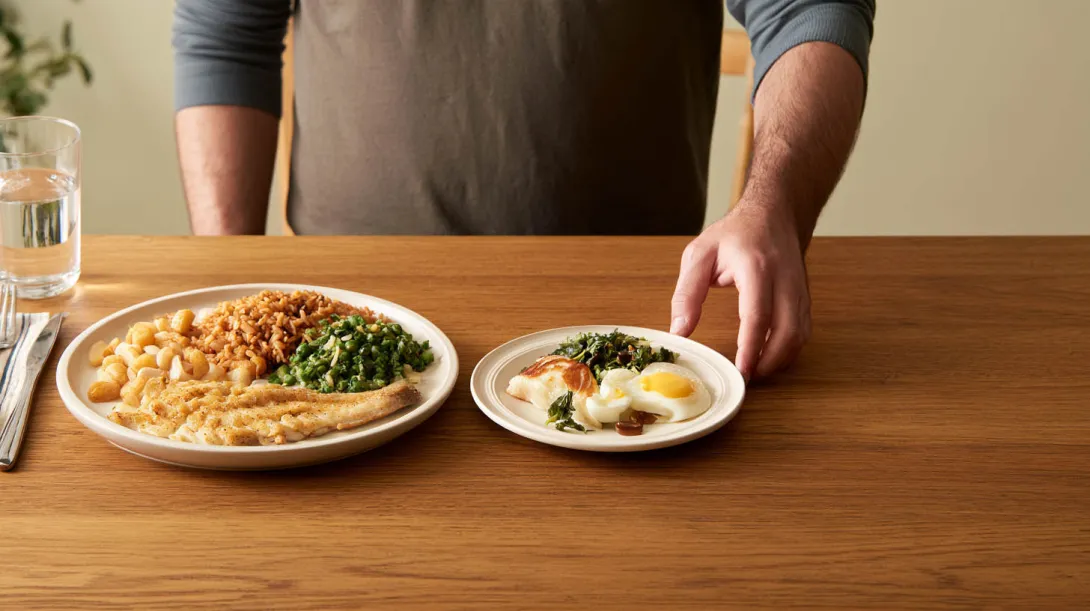
GLP-1 medications have changed the conversation around weight management. They can substantially reduce appetite and food intake, making smaller portions feel natural rather than forced. But that creates a nutritional question that is easy to overlook.
What happens when food intake falls faster than nutritional needs?
The answer is not simply to eat more. It may be to make the food that is eaten work harder.
Smaller appetite, different nutrition problem
When appetite decreases, portion size often follows. Yet the body's requirements for protein, essential fatty acids, vitamins, minerals and other nutrients do not necessarily decline in proportion to calorie intake.
This changes the practical logic of a meal.
With a larger energy intake, there is more room for foods that contribute calories without providing much protein, fiber or micronutrient value. With a much smaller portion, that room becomes limited. The nutritional quality of each bite starts to matter more.
This is where nutrient density becomes particularly relevant.
Rather than asking only, "How many calories are in this meal?", another question becomes useful: "What does this amount of food actually provide?"
Weight loss is not only fat loss
There is another complication.
A lower number on the scale does not tell us what was lost. Body-composition research during GLP-1 treatment shows that most weight reduction can come from fat mass, but lean mass may decrease as well. Importantly, lean mass is a broader category than muscle alone, so the two terms should not be treated as interchangeable.
That distinction matters because the goal of weight management is not simply to make the body lighter.
Preserving physical function remains important. Adequate nutrition and physical activity, particularly resistance exercise, therefore continue to have a role even when medication is producing substantial weight loss.
The scale measures mass. It does not measure strength, physical capacity or nutritional adequacy.
Every bite has more work to do
These two issues meet at the same point.
If someone is eating considerably less while also trying to preserve lean tissue and maintain adequate nutrition, food selection becomes more consequential.
Protein deserves attention because it supports the maintenance of body tissues. Fiber remains important even when the volume of food decreases. Nutrient-rich foods can help deliver vitamins, minerals and other useful components within a smaller energy and food-volume budget.
This does not mean that every meal has to become nutritionally perfect. Nor does it mean that foods should be reduced to a checklist of nutrients.
It suggests a change in priorities.
When appetite is low, it can make sense to give protein, fiber and nutrient-rich foods space on the plate before filling a limited portion with foods that contribute relatively little nutritional value.
Nutrient density may become more important
The rise of GLP-1 therapies may therefore influence nutrition beyond weight-loss advice.
For decades, much of the public conversation around weight management has focused on reducing calories. In a context where appetite itself can be strongly suppressed, the problem begins to look different.
The question is no longer only how to reduce intake.
It is also how to maintain nutritional quality when intake has already been reduced.
That shift may have implications for meal planning and, potentially, for how foods intended for smaller appetites are formulated. A smaller meal is not necessarily just a reduced version of a larger one. It may need a higher nutritional return from the food that remains.
In that sense, the GLP-1 era introduces a useful paradox: eating less can make food quality more important, not less.
Scientific basis
This article is based on the research themes reviewed for this GLP-1 nutrition series: studies of appetite and reduced food intake during GLP-1 receptor agonist treatment; body-composition research examining fat mass and lean mass during weight loss; evidence supporting adequate protein intake and resistance exercise for preservation of functional tissue; and emerging discussion around nutrient density when overall food intake is reduced.